
Custom Plush Development
Custom Plush Toy Samples: How to Reduce Revisions and Keep Bulk Production Consistent
Why custom plush samples often need repeated revisions—and how brands can protect character accuracy when an approved sample moves into bulk production.
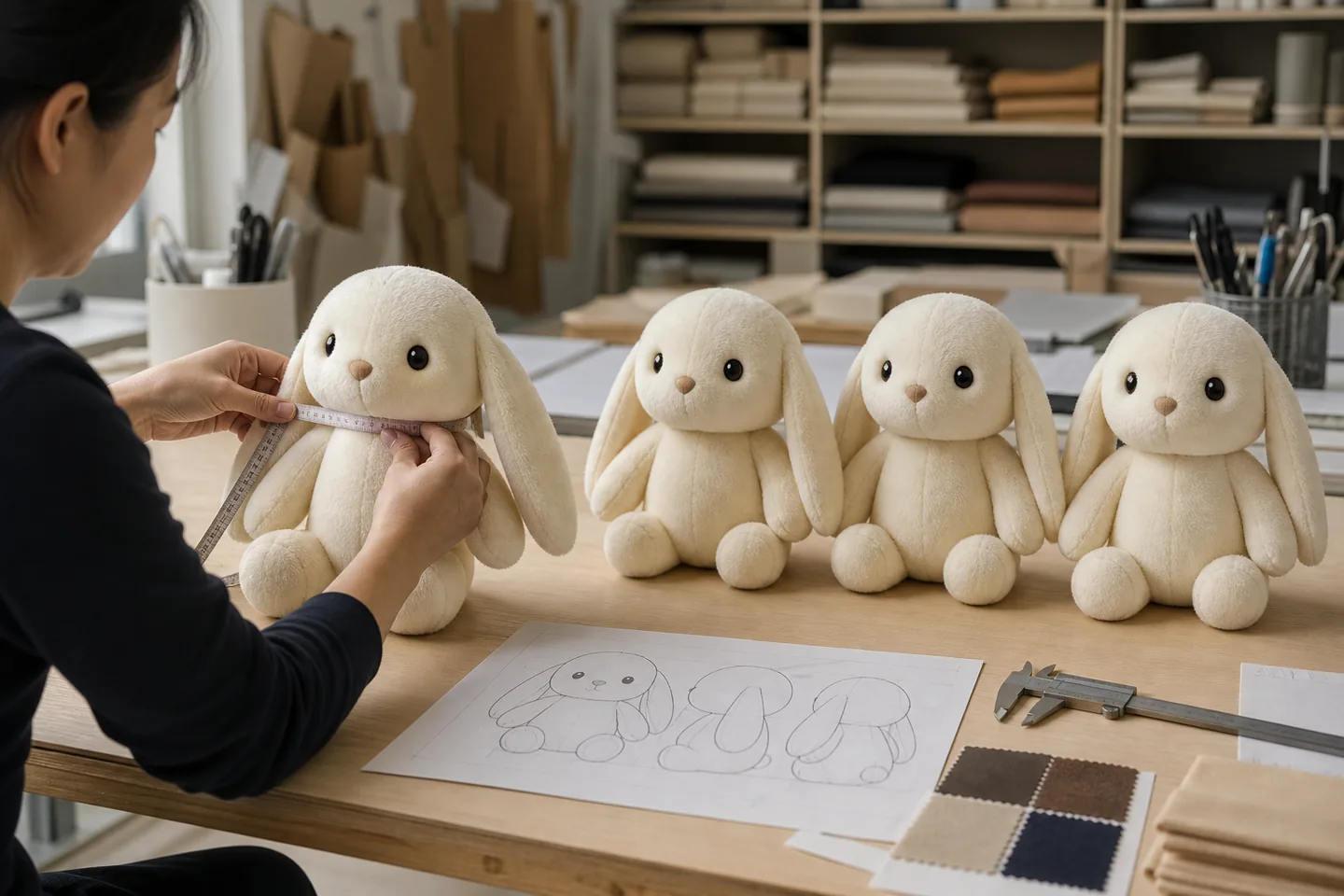
A custom plush toy sample can look “almost right” and still feel wrong. The face may be slightly flat, the ears may sit at the wrong angle, the fabric may change the character’s expression, or the body may lose the silhouette of the artwork. After several revisions, the sample is finally approved—but the bulk order may still drift away from it.
For a brand or IP owner, this is more than a design inconvenience. Repeated revisions delay internal approval and product launches. Inconsistent bulk production can lead to rework, complaints, returns and damage to the character’s value. The practical goal is therefore not only to make one attractive prototype. It is to turn the approved appearance into a repeatable production standard.
1. Why a good drawing can become the wrong plush toy
A two-dimensional character does not contain every decision needed for a three-dimensional product. A pattern maker must interpret depth, side profile, seam position, stuffing, balance and how fabric behaves around curves. Two factories can follow the same image and produce very different results because they make different structural decisions.
The most sensitive area is usually the face. Eye spacing, embroidery size, muzzle volume and the angle between the head and ears may each differ by only a few millimetres, yet together they change the expression. Long-pile fabric can hide embroidery or seams; short-pile fabric can make the same shape look sharper. These choices should be reviewed as one visual system, not as isolated parts.
2. The five details that cause most sample revisions
- Proportion and silhouette: head-to-body ratio, limb length, sitting height and side profile.
- Face and expression: eye position, embroidery scale, symmetry, muzzle shape and ear angle.
- Fabric and color: pile length, direction, stretch, hand feel and color under real lighting.
- Structure and stuffing: firmness, balance, internal support and whether the product can sit or stand as intended.
- Accessories and assembly: clothing fit, removable parts, attachment strength and repeatable positioning.
A useful sample review does not simply say “make it cuter” or “the face is still not right”. It identifies which dimension, angle, color or construction must change. Marked photographs and one consolidated revision list help the sampling team act on the same instruction.
3. What buyers should prepare before sampling
You do not need a complete technical pack to begin, but the factory needs enough context to make the right decisions. Send the clearest available front, side and back references; the target size; intended use; target market; quantity range; packaging idea; and any parts that must move, detach or contain electronics.
Also identify the character’s non-negotiable features. For one IP it may be the eye spacing and round face; for another it may be an oversized head, a particular sitting pose or a distinctive accessory. When these priorities are known early, the sampling team can protect them while adjusting less important details for manufacturability.
4. A sampling process that reduces blind revisions
- Project review: confirm use, size, market, quantity, key visual features and timing.
- Material and structure direction: agree on fabric character, color range, construction and important accessories.
- First sample: review overall likeness before spending time on small decorative details.
- Structured correction: combine feedback into one version, with priorities and annotated images.
- Approval: confirm the physical sample and record the specifications needed for production.
This sequence helps avoid a common problem: refining embroidery, clothing or packaging while the basic silhouette is still wrong. Correcting the largest visual and structural issues first normally makes later reviews faster and clearer.
5. How to turn an approved sample into a production standard
An approved sample should be supported by production information, not treated as the only reference. Key dimensions, pattern version, fabric and color references, embroidery or print files, accessory position, stuffing and firmness, seam construction and packaging requirements should be recorded in a form the production team can repeat.
The approved reference also needs clear ownership. If comments continue to arrive through separate messages after approval, production teams may work from different versions. One confirmed reference, one change log and one person responsible for final approval reduce that risk.
6. How bulk production stays closer to the approved sample
Consistency is built before the full order is completed. Material confirmation protects pile, hand feel and color. First-piece approval checks whether the production line is following the approved construction. In-process inspection identifies shifts in embroidery, sewing, stuffing or assembly while they can still be corrected. Final inspection checks appearance, workmanship, quantity and packaging against the agreed plan.
Character products also need visual checkpoints. A seam can be technically sound while the face is visibly unbalanced. The buyer and manufacturer should agree which visual details define the character and how they will be judged. This is the difference between checking a generic stuffed product and protecting an IP product.
7. What this process gives the buyer
A controlled sampling and production process gives the project team practical benefits: fewer unclear revision rounds, faster internal decisions, earlier visibility of production risks, less chance of bulk goods drifting from the approved sample, and a more predictable launch or delivery schedule.
It also protects the work already invested in the character. When the physical product keeps the correct face, proportion, hand feel and presentation, it is easier for retailers, licensing partners and consumers to recognise the intended brand value.
How MofuDream supports sample-to-production consistency
MofuDream combines toy manufacturing experience since 2007 with a sampling and design team of more than 50 people. Our manufacturing system includes four production bases, more than 2,000 team members, over 1,000 pieces of equipment and monthly capacity above 900,000 units. These resources matter because sampling, engineering, production management and quality checks must work as one system.
We support high-fidelity sampling, structural and process optimisation, controlled mass production, packaging coordination and domestic handoff in China. Supplier-qualification materials related to ISO 9001, ICTI, BSCI and FAMA can be reviewed for relevant projects. You can see our custom plush development capabilities and take a virtual look at our plush toy factory.
If you are still comparing suppliers, read our buyer’s guide to choosing a custom plush toy manufacturer. It explains what to check before you shortlist a production partner.
Frequently asked questions
How many sample revisions will a custom plush toy need?
There is no fixed number. Complexity, artwork quality and the clarity of feedback all affect the result. A structured brief and consolidated revision list usually reduce avoidable rounds, but the priority should be a production-ready approved sample rather than an arbitrary revision count.
Can a factory guarantee that every bulk unit is identical to the sample?
Textile products have normal production variation, so a responsible factory should not promise mathematical identity. The right objective is to define acceptable tolerances and protect the visual and functional features that matter most through material control, first-piece approval and process inspection.
When should testing and compliance requirements be discussed?
Before or during sampling. Destination market, age grade, materials, attachments and interactive parts may affect construction and testing. Early discussion reduces the risk of redesign after appearance approval.
What should I send MofuDream for an initial review?
Send your artwork or reference product, target size, approximate quantity, market, expected timing and the features that must be preserved. Use the project inquiry form; our team will identify the next information needed for sampling and production review.